No SaaS
Salesforce spent years teaching the market to chant no software. Then enterprises conformed to SaaS products rather than the reverse. The bargain made sense when custom software was expensive, slow, and trapped inside IT. AI changes that calculus.
Keep the boring utilities. But the moment software starts touching your judgment, your workflow, your brand voice, or your edge, you are not buying a tool. You are deciding whether what makes your company yours lives inside the business or inside someone else's schema.
Looking for the original statement? Read the original No SaaS manifesto.
Then: No software
Now: rented stack
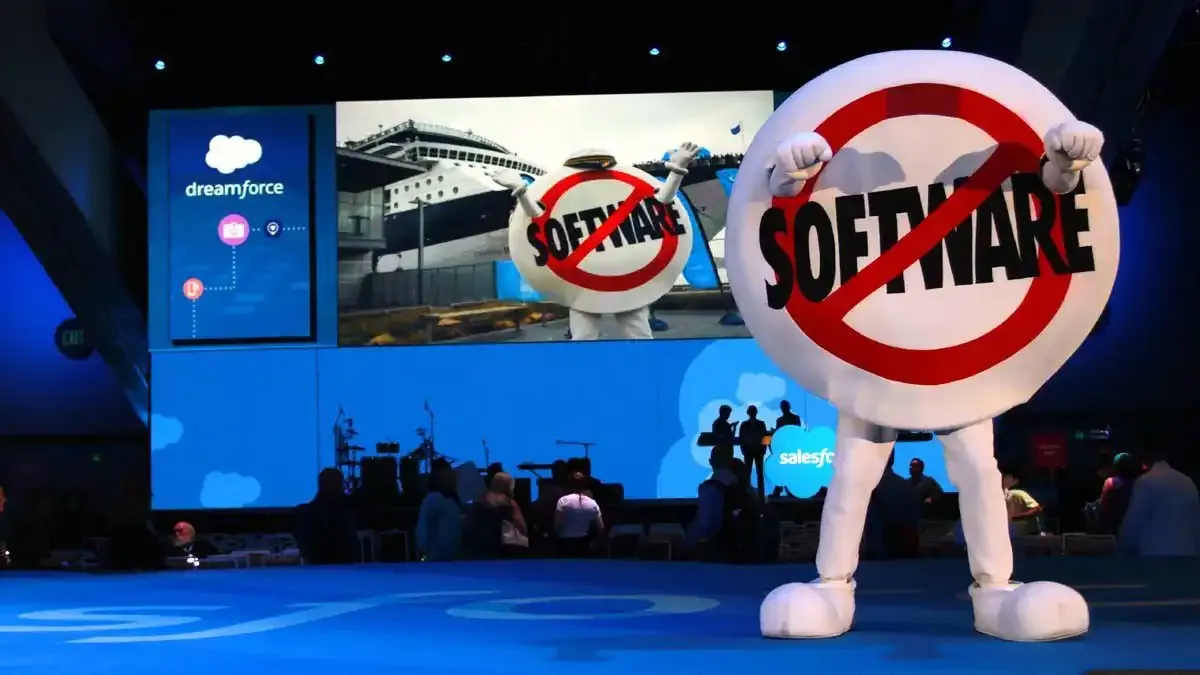
Generation-defining promise
Renting software felt like liberation when installation was the enemy.
The flip
Technology conforms to your enterprise, not the reverse.
BetterCloud says the average company still runs 106 SaaS apps in 2026.
BenchSights put median public SaaS ARR growth at 15% in Q2 2025. The curve is not pointing back up yet.
A strong coding harness can take an idea to a working internal tool before procurement would have finished the intake form.
The Bargain
That promise was real. Custom software used to mean big budgets, long timelines, and a tolerance for large, slow IT teams. SaaS replaced installation hassles with a browser tab and a credit card. Of course it won.
The catch was hidden inside the convenience. Enterprises conformed to SaaS products rather than the other way around. A vendor's schema became the canonical record. Approval chains, permissions, workflows, and definitions of success arrived preloaded.
AI changes the economics because qualitative work is now programmable. When AI is combined with code and unique knowledge contained only inside the enterprise, you can build systems that answer harder questions, operate at a different speed, and actually fit the business.
James Gross put it plainly in Software Built For You: the old world forced companies to fit into rigid templates; this one lets them build systems tailored to their unique DNA.
The Mold
Once a vendor's schema becomes the canonical record, its data gravity pulls every upstream and downstream team into orbit. People start speaking the platform's language. Soon the software is not reflecting the organization. The organization is reflecting the software.
That is the heart of The SaaS Industrial Complex. Strategic sameness. Org-chart inflation. An innovation ceiling tied to someone else's sprint board. When every company runs the same stack, sameness stops looking like efficiency and starts looking like surrender.
The future of business strategy isn't just about making better decisions - it's about building better decision-making machines.
Source: Strategic Software
The market appears to be telling us the same thing. Public SaaS no longer looks like a law of nature. It looks like a mature category running into a new interface layer.
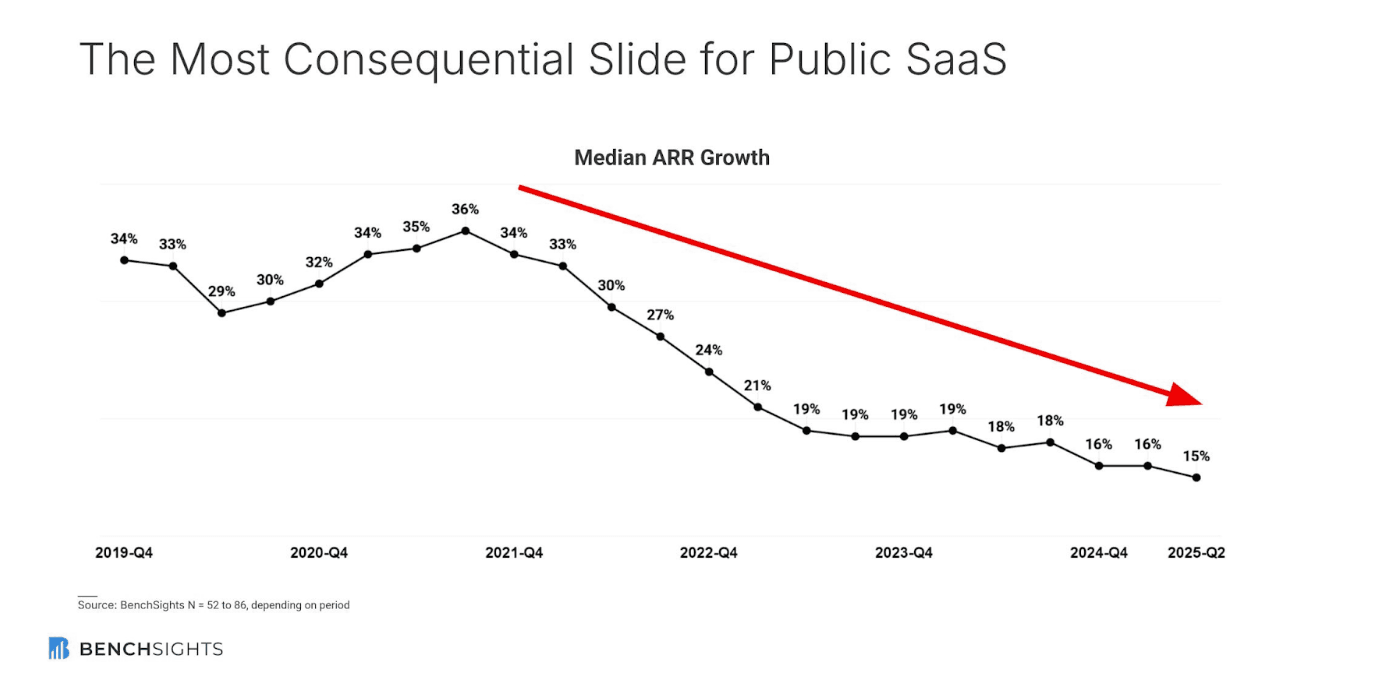
Source: BenchSights, shared in Noah's Bloomberg Odd Lots recap. Median public SaaS ARR growth fell to 15% by Q2 2025.
Private Tokens
Your organization's unique communication, decision-making, and problem-solving create an irreplaceable layer of intelligence. In practice that means briefs, call notes, strategy docs, naming conventions, weird approval shortcuts, and the list of things a good operator notices before anybody else notices them.
We call those assets private tokens. Think of them as your company's digital DNA. Public models can get you the median result on almost anything. Private-token systems understand your language, your customers, your challenges, and your standards.
This is where the old SaaS model starts to look backwards. Static platforms flatten the differences that matter. Systems powered by private tokens grow smarter with every interaction. Every conversation and internal discussion can enhance the software's capabilities.
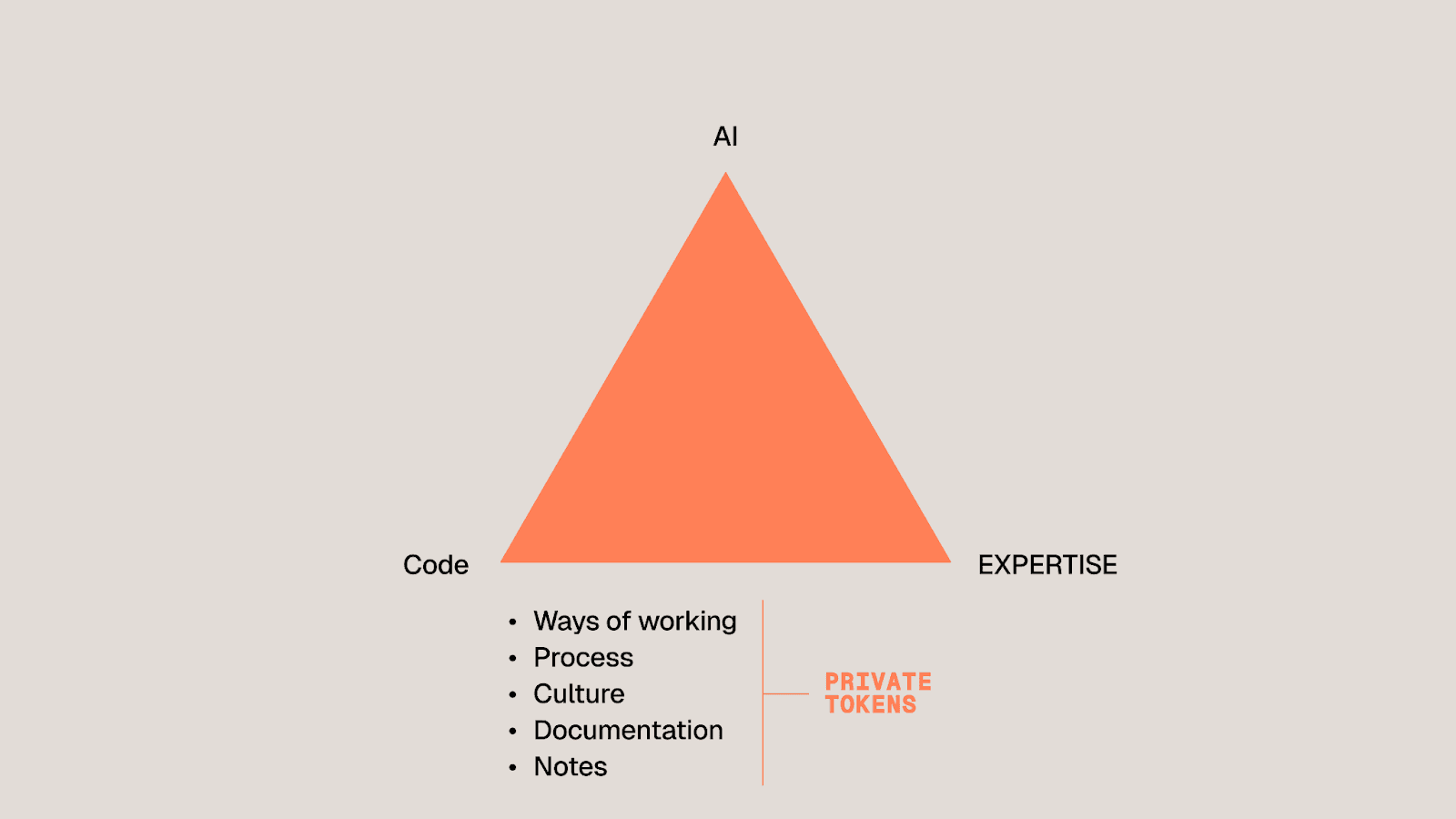
Your private tokens stay private. Your workflows stop drifting toward the lowest common denominator.
What Replaces It
No SaaS is not a manifesto against subscriptions. Keep payroll. Keep email. Keep the boring utilities. The line is simpler: if the software shapes your differentiation, do not rent it.
What replaces it is not a giant internal platform team rediscovering why product management exists. It is a much tighter loop: proper context engineering, strong coding harnesses, senior builders, and software that touches the real workflow immediately.
What was once unthinkable is now doable. Projects that once took months can now be completed in weeks, and the best teams can go from “I have an idea” to “I have a working tool” fast enough that procurement does not get to harden into strategy.
Workflow shape
Alephic
Built around your actual workflow
SaaS
Defined by the vendor
Consultants
Mapped in slides
Learns your private tokens
Alephic
Yes
SaaS
Only where configuration allows
Consultants
Only as recommendations
Time to working software
Alephic
Days to weeks
SaaS
Already built for everyone else
Consultants
Never
Ownership
Alephic
You own the capability
SaaS
The roadmap stays outside
Consultants
No code to transfer
How it gets better
Alephic
Grows smarter with every interaction
SaaS
Improves on the vendor schedule
Consultants
Stops at the recommendation
Proof
Amazon CopySAW
Amazon's internal copy system encodes brand voice, product context, and creative judgment instead of forcing copywriters into a generic workflow.
Case StudyEY Content Matrix
EY turned 140,000-plus documents into a scoring engine grounded in the firm's own rubric, language, and institutional memory.
Case StudyLands' End
Lands' End built a merchandising and catalog system that makes layout, image, and copy decisions with real business feedback in the loop.
Related Reading
Original No SaaS Manifesto
The original Alephic statement: hundreds of tools, zero understanding, and why generic SaaS was always somebody else's compromise.
EssayStrategic Software
The clearest statement of the shift: the build-vs-buy question is no longer confined to IT and operations.
EssaySoftware Built For You
James Gross on the flip from enterprises conforming to SaaS products to technology conforming to the enterprise.
EssayThe SaaS Industrial Complex
How vendor schemas become canonical records, create strategic sameness, and turn their mirror into your mold.
Podcast RecapClaude Code and the AI Coding Boom
Why the same forces reshaping how software gets built are broadening out to other functions and business processes.
Utilities can stay rented
But if the software shapes your language, your workflow, your judgment, or your edge, build the thing that matches your DNA and gets smarter every time your team uses it.
Further Reading
Eisenhower's Farewell Address ↗
The original warning about industrial systems that become too entangled with the incentives meant to constrain them.
PaperConway's Law ↗
Mel Conway's original framing of why systems inherit the structure of the organizations that build them.
DataSaaS Statistics 2026 ↗
A current view of SaaS sprawl, consolidation, and why the average company is still carrying a surprisingly large stack.
HistoryA Brief History of Salesforce ↗
A useful history of the original "No Software" campaign and the era when SaaS genuinely felt like liberation.
Ready to stop renting your edge?
We embed senior builders with your team to turn private tokens, source material, and workflow exceptions into software that compounds.