The Variance Spectrum
This framework started with a nagging question: why isn't there a centralized “system of record” for marketing the way there is for finance (ERP) or sales (CRM)? The best answer has to do with the nature of marketing's output itself.
Finance, governed by GAAP standards and mandated tax forms.
A mix of process and methodology plus the art of the deal.
Each campaign and piece of content meant to differ from the last.
The Spectrum
The idea can be plotted as a spectrum. The left side represents zero variance—the territory of manufacturing and Six Sigma, where the whole point is that every output is identical to the last. The right side is 100 percent variance, where R&D and innovation reign supreme, and each output differs fundamentally from what came before.

The poles help explain it, but it's what you place in the middle that makes it powerful. Finance sits far left since so much of its output is “governed”—quite literally the government sets GAAP accounting standards and mandates specific tax forms. Sales lands somewhere in the middle: a pretty good mix of process and methodology plus the “art of the deal.” Marketing sits off to the right, just behind R&D.

That placement explains the system-of-record problem. The variance of marketing's output—the fact that each campaign and piece of content is meant to be different than the one that came before it—makes for an environment that at first seems opposed to the basics of systemization that the rest of a company has come to accept.
Fractal Variance
But that's just the first layer. Companies are hierarchical, and at any point on the spectrum you can drill in and find a whole new spectrum of activities ranging from low variance to high variance.
Finance may be “low variance” on average thanks to government standards, but forecasting and modeling is most certainly high variance: something that must be imagined in original ways depending on the company, its products, and its markets. Zoom into marketing and you find the same thing—brand governance sits far to the low-variance side while creative development clearly occupies the other pole.
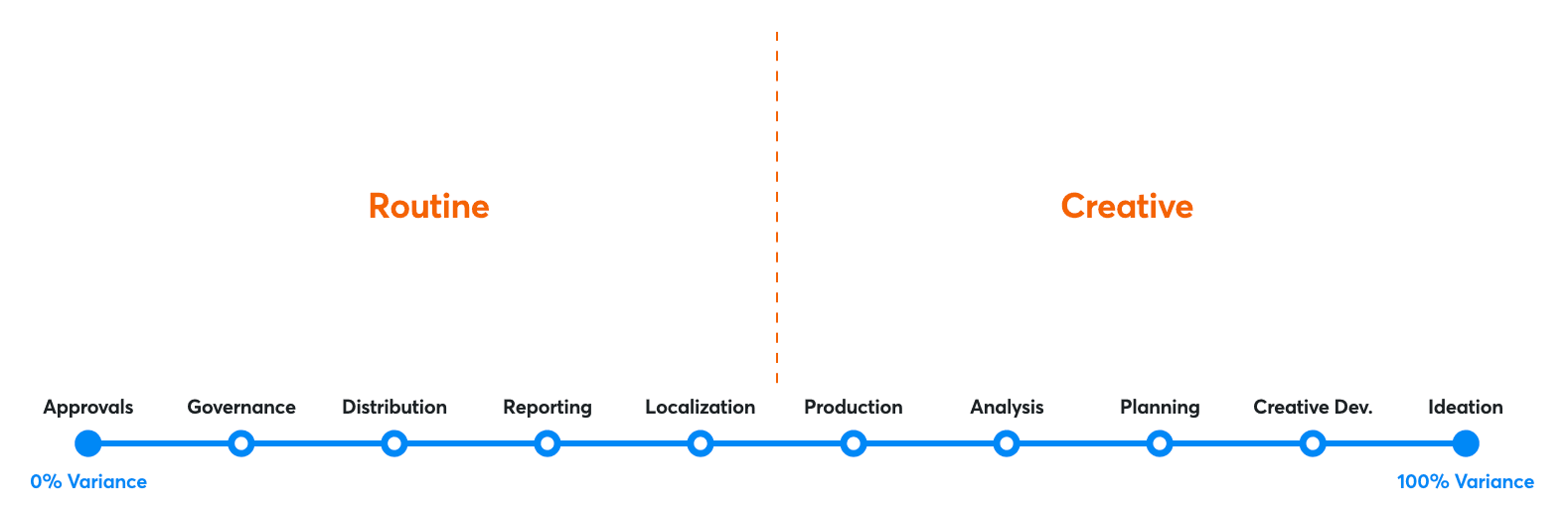
Another way to articulate these differences is that the low variance side represents the routine processes and the right the creative. The left side is where you have the most clarity about the final goal—in manufacturing you know exactly what you want the output to look like when it's done. The right side holds the most ambiguity—the goal of R&D is to make something new.
The fractal goes one more level. Inside any given activity, the rulesthat govern it sit on their own spectrum. Some rules are zero-variance—the logo you use, the legal disclaimer, the brand name. No one messes with them, ever. Other rules are closer to guidance—tips, best practices, ideas about what's worked before. Those aren't meant to be enforced; they're meant to orient. A lot of organizational friction comes from confusing the two: treating guidance as a mandate, or treating a mandate as a suggestion.
Output, or Input?
So far the spectrum has been described in terms of output—how much each end result differs from the last. But there's a cleaner way to frame it. Instead of asking how variable the output is, ask: how many different ways can this job be done?
Manufacturing has one way. If you don't build it that way, you've built it wrong—you don't want someone experimenting on the production line. R&D has many. There are methods, sure, but there's no single right path, and the whole point is to find one nobody's found before.
The input framing tells you what to do about each end. On the low-variance side, collapse the ways of working into one—that's where mandates, choke points, and automation belong. On the high-variance side, forcing one way is how adoption dies. You want to capture the work without constraining the process. In the middle you drive the stages and gates but leave the tasks and time alone.
The Roots
The plotting may be new, but the underlying idea—that there are different kinds of tasks inside a company—is not. Organizational theorists Richard Cyert, Herbert Simon, and Donald Trow noted this duality in a 1956 paper called “Observation of a Business Decision”, where they drew a line between what they called programmed and non-programmed decisions.
At one extreme we have repetitive, well-defined problems involving tangible considerations, to which the economic models that call for finding the best among a set of pre-established alternatives can be applied rather literally. In contrast to these highly programmed and usually rather detailed decisions are problems of a non-repetitive sort, often involving basic long-range questions about the whole strategy of the firm. In this whole continuum, from great specificity and repetition to extreme vagueness and uniqueness, we will call decisions that lie toward the former extreme programmed, and those lying toward the latter end non-programmed.
Simon, of course, went on to develop the concept of satisficing—the idea that humans don't optimize, they find something good enough and move on. The connection to the variance spectrum is direct: on the left side, where problems are well-defined, you canoptimize. On the right side, you can't even define what optimal looks like. You satisfice.
For that reason, high variance tasks should also fail far more often than their low variance counterparts. Nine out of ten new product ideas might be a good batting average, but if you are throwing away 90 percent of your manufactured output you've massively failed.
Simon extended this in Administrative Behavior, pointing out that “the task of 'deciding' pervades the entire administrative organization quite as much as does the task of 'doing.'” Another way of saying the spectrum is fractal—every action contains a decision, and every decision sits somewhere on the continuum. Cyert went on to collaborate with James March on A Behavioral Theory of the Firm, which remains the definitive statement of this tradition.
Structured Drives Out Unstructured

Even though it may be tempting, that's not a reason to focus purely on the well-structured, low-variance problems. Richard Cyert laid out the danger in a 1994 paper called “Positioning the Organization”:
It is difficult to deal with the uncertainty of the future, as one must to relate an organization to others in the industry and to events in the economy that may affect it. These activities are less structured and more ambiguous than dealing with concrete problems. Many experiments show that structured activity drives out unstructured. For example, it is much easier to answer one's mail than to develop a plan to change the culture of the organization. The implications of change are uncertain and the planning is unstructured. One tends to avoid uncertainty and to concentrate on structured problems for which one can correctly predict the solutions and implications.
This is the gravitational pull of the left side of the spectrum. Structured activity drives out unstructured. It's easier to answer email, check boxes, attend meetings—the routine stuff—than to sit with the ambiguity that high-variance work demands. Most organizations optimize for the left because it's measurable and comfortable. But the value disproportionately lives on the right.
This is also, incidentally, why bureaucracy metastasizes. Every low-variance process that gets added—every approval chain, every governance layer—crowds out the space for high-variance creative work. The sabotage manual didn't need to invent a way to destroy organizations. It just described what happens when you let the structured side win.
Two Kinds of Solutions
Going a level deeper, another way to cut the spectrum is based on how you should actually solve the problem. For routine tasks on the left, you want a single way of doing things—push down the variance of the output. On the high-variance side you need the freedom to try different approaches. In software terms: automation and collaboration respectively.
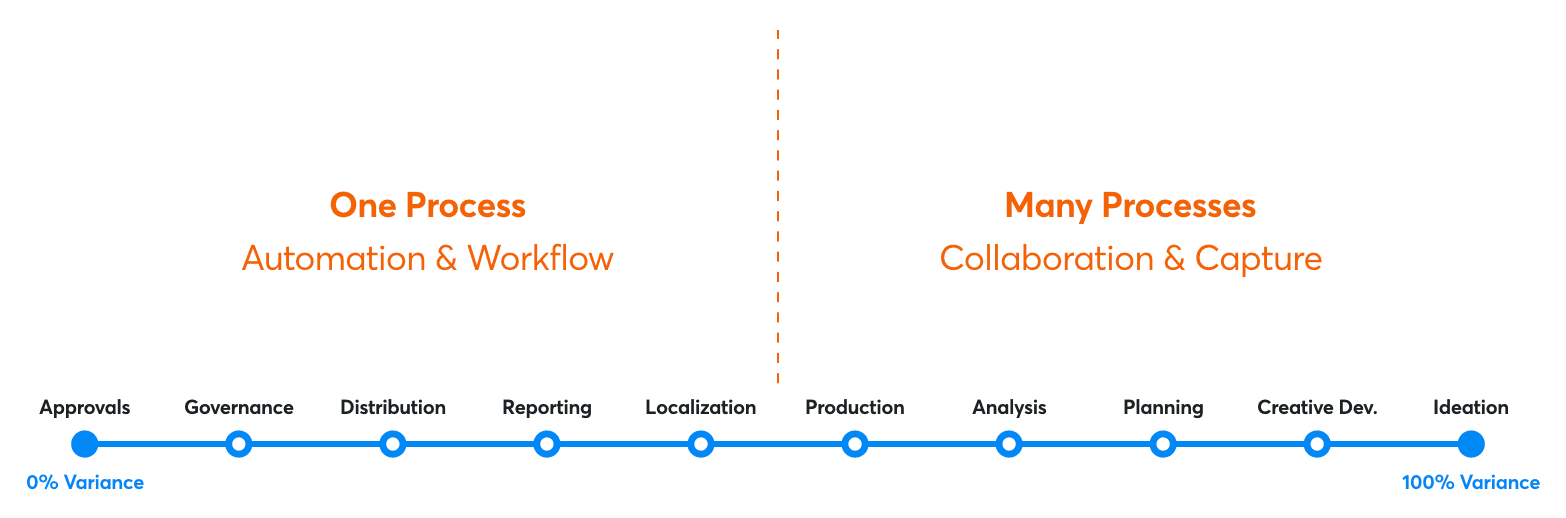
This explains so much about the SaaS industrial complex. Most SaaS tools are designed for the left side of the spectrum—they encode a single way of doing things and ask you to conform. That works brilliantly for payroll processing. It's a disaster for content strategy. Their mirror becomes your mold.
The caveat: high-variance work can develop its own rigor over time. Pixar has a process. So did Ogilvy. So did James Baldwin. The difference is that their processes were earned from inside the work, not handed down from a vendor. Imported structure fails on the right side of the spectrum; organic structure can succeed because the team builds the rails as they learn what the work actually needs.
AI is different. AI is malleable—it can operate across the entire spectrum, automating the routine stuff on the left andserving as a creative collaborator on the right. A conventional project management tool can only live on the left, which is why every creative team that gets handed one quietly routes around it. That's why AI is the first technology with a genuine shot at beingmarketing's system of record. It meets the work where it actually is, rather than imposing structure.
A Management Tool
The variance spectrum is primarily a framework for thinking about process, but it has a more personal use. Employees over- or misinterpret feedback from senior people all the time. A casual aside about color choice in a design comp gets misconstrued as an order to change when it wasn't meant that way.
The spectrum can make feedback explicit: is this a low-variance directive you expect to be acted on, or a high-variance comment that is simply two cents? Labeling it helps avoid ambiguity and signals respect for expertise. “This is high-variance feedback” becomes a useful shorthand for “thinking out loud, not giving an order.”
Related Reading
Further Reading
Observation of a Business Decision ↗
Cyert, Simon, and Trow on programmed vs non-programmed decisions (1956).
ReferenceHerbert A. Simon ↗
Nobel laureate behind satisficing, bounded rationality, and the programmed/non-programmed decision framework.
GlossaryConway's Law
Organizations produce systems that mirror their own communication structures.
ReferenceJames G. March ↗
Cyert's collaborator on A Behavioral Theory of the Firm. Garbage can model, exploration vs exploitation, the robust beauty of little ideas.
“The variance of marketing's output—the fact that each campaign and piece of content is meant to be different than the one that came before it—made for an environment that at first seemed opposed to the basics of systemization that the rest of a company had come to accept.”
— Noah Brier, Co-founder of Alephic
Ready to work across the spectrum?
We build custom AI systems that work across the entire variance spectrum — automating the routine stuff and collaborating on the work that has to be different every time.